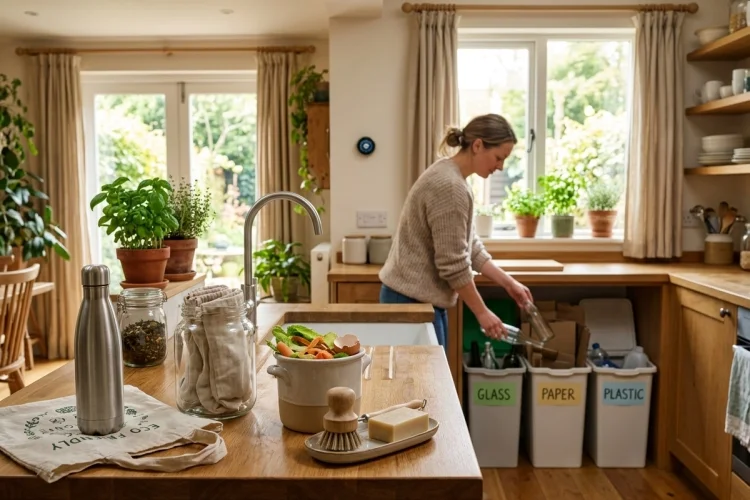
Making your home greener can sound like an expensive project involving solar panels, major renovations, and replacing every appliance you own. Fortunately, creating a more sustainable home does not have to start with a huge investment.
Many environmentally friendly changes are surprisingly simple. Switching off unnecessary lights, wasting less food, fixing a dripping tap, using reusable products, and becoming more thoughtful about what you buy can all reduce your household’s environmental footprint.
The best approach is usually to start small.
Learning simple ways to make your home more environmentally friendly is less about achieving a perfectly sustainable lifestyle and more about making better everyday choices.
Some changes can also lower household expenses by reducing electricity, water, and unnecessary purchases. Energy efficiency, for example, means using less energy to accomplish the same task, which can reduce both utility costs and pollution.
Here are practical changes you can introduce without completely redesigning your home.
1. Reduce Everyday Energy Waste
One of the easiest places to begin is with the energy you already use.
Turn lights off when nobody needs them. Avoid leaving televisions, computers, and other electronics running unnecessarily. When replacing appliances or equipment, consider energy efficiency as part of your buying decision.
Lighting is another easy opportunity.
EPA notes that ENERGY STAR-certified efficient light bulbs can use up to 90% less energy than traditional incandescent bulbs while providing the same basic job: lighting a room.
You do not need to replace every bulb immediately.
Instead, switch to more efficient lighting when existing bulbs reach the end of their useful life. This reduces unnecessary purchases while gradually improving your home’s energy efficiency.
Pay Attention to Heating and Cooling
Heating and cooling can also consume substantial amounts of household energy.
Avoid heating or cooling empty rooms unnecessarily, and keep doors and windows closed when air conditioning or heating is operating. Weatherstripping around doors and windows can also reduce unwanted heat transfer.
Simple habits matter because the greenest unit of energy is often the one you never needed to use.
2. Save Water Without Making Life Difficult
Water conservation does not require taking uncomfortable two-minute showers.
Start by looking for obvious waste.
A dripping tap, leaking toilet, or damaged pipe can waste water continuously without attracting much attention. EPA notes that a leaking toilet can waste as much as 200 gallons of water per day in some cases.
Fixing leaks is therefore one of the simplest environmental improvements you can make.
You can also turn off the tap while brushing your teeth, avoid running water unnecessarily when washing dishes, and wait until you have a suitable load before running washing machines or dishwashers.
When fixtures eventually need replacing, look for water-efficient alternatives.
EPA’s WaterSense program provides information about products designed to use water more efficiently.
Saving water can also reduce energy consumption because energy is required to pump, treat, distribute, and heat water.
3. Reduce Before You Recycle
Recycling is useful, but it should not be your only strategy for household waste.
A better question is whether the waste needed to exist in the first place.
EPA promotes the familiar approach of reduce, reuse, and recycle, with reduction and reuse helping households decrease the amount of material entering the waste stream.
Start by reducing unnecessary disposable items.
Use reusable shopping bags, water bottles, food containers, coffee cups, and cleaning cloths when they make sense for your lifestyle.
Before throwing something away, consider whether it can be repaired, donated, sold, or reused.
An old jar can become food storage. Furniture may be repairable. Clothes in good condition can be donated rather than discarded.
And before buying something new, ask a simple question:
Do I actually need this?
Often, the easiest way to reduce household waste is to bring fewer unnecessary things into your home.
4. Waste Less Food
Food waste has both environmental and financial costs.
EPA estimates that about one-third of food in the United States goes uneaten, making food waste prevention an important household sustainability opportunity.
You can reduce waste by planning meals before shopping.
Check your refrigerator and cupboards first, then build your grocery list around what you actually need. Store food properly and place items that need to be eaten soon somewhere visible.
Leftovers can also become ingredients rather than waste.
Yesterday’s roasted vegetables can go into an omelette. Leftover rice can become fried rice. Overripe fruit can be added to smoothies or baked dishes.
Freezing extra portions is another useful habit.
The goal is not to eliminate every forgotten carrot from your life. It is simply to become more intentional about buying, storing, and using food.
5. Try Composting Organic Waste
Even with careful meal planning, households still generate unavoidable food scraps.
Some of that organic material can potentially be composted instead of thrown away.
EPA describes composting as nature’s way of recycling. Food scraps and garden materials can be transformed into compost that can support healthier soil.
If you have outdoor space, a simple backyard compost system may work.
Depending on the setup, suitable materials can include fruit and vegetable scraps, coffee grounds, dry leaves, and certain garden trimmings.
Apartment residents are not necessarily excluded either.
Vermicomposting uses worms to process suitable organic waste in relatively compact systems. Some communities also provide food-scrap collection or drop-off programs.
Check local rules and services because composting and waste collection options vary significantly between locations.
6. Choose Household Products More Carefully
Cleaning products are another area where small purchasing choices can matter.
You do not necessarily need a separate chemical product for every surface in the house.
Use products according to their instructions and avoid buying cleaners you rarely need.
When shopping, you can also look for recognised environmental or safety certifications instead of relying only on marketing words such as “natural” or “green.”
In the United States, EPA’s Safer Choice label identifies qualifying products whose ingredients have been reviewed against health and environmental criteria. The program also includes performance requirements.
EPA’s searchable database currently includes a large range of certified household and commercial products.
Regardless of which products you choose, follow label directions carefully and store household chemicals safely.
7. Buy Less and Choose Things That Last
An environmentally friendly home is not necessarily filled with brand-new “eco” products.
Sometimes the more sustainable option is simply continuing to use what you already own.
Replacing a functioning reusable bottle with a fashionable sustainable bottle still creates another product that had to be manufactured and transported.
When something genuinely needs replacing, think about durability.
A product that lasts for many years may be more useful than repeatedly buying cheaper items that quickly break.
Consider repairing appliances, furniture, clothes, and household items when practical.
Second-hand shopping can also extend the useful life of existing products. Furniture, kitchen equipment, books, clothing, and decorative items do not always need to be purchased new.
Sustainability is not just about choosing different products. It can also mean consuming fewer of them.
8. Make Your Laundry Routine Greener
Laundry offers several small opportunities to reduce household resource use.
Avoid washing tiny loads unless necessary. Waiting for an appropriate load makes better use of the water and energy involved in each cycle.
Cold-water washing can also work for many everyday garments, depending on fabric, detergent, hygiene requirements, and care instructions.
Drying clothes naturally can reduce dryer use when weather, space, and local conditions allow.
You can also help clothing last longer by following care labels instead of washing everything using the hottest or most aggressive settings.
Keeping clothes wearable longer reduces the need to replace them as frequently.
Again, sustainable living often comes back to extending the useful life of things you already have.
9. Improve Recycling by Learning Your Local Rules
Putting everything that looks recyclable into one bin can actually create problems.
Recycling rules vary between communities.
Some programs accept certain plastics, glass, paper, and metal while others have different requirements. Batteries and electronics often need completely separate collection systems.
Check your local recycling authority’s instructions instead of guessing.
Keep recyclable materials reasonably clean when required and avoid placing non-accepted materials into recycling simply because you hope they are recyclable.
EPA also provides specific information about handling used electronics and batteries because these items require different management from ordinary household rubbish.
Good recycling is not about filling the recycling bin as quickly as possible.
It is about putting the correct materials in the correct waste stream.
10. Change Your Habits Before Renovating Your House
Major upgrades such as improved insulation, efficient appliances, renewable energy systems, and water-saving fixtures can certainly make homes more environmentally friendly.
But you do not need to begin there.
Start with your behaviour.
Track where electricity, water, food, and household products are being wasted. Then fix the easiest problems first.
Perhaps your first month involves replacing inefficient bulbs as they fail and repairing a leaking tap.
Next month, focus on meal planning and reducing food waste.
After that, improve recycling or begin composting.
Gradual changes are easier to maintain because they become part of your normal routine instead of feeling like a temporary environmental challenge.
The simple ways to make your home more environmentally friendly are often the same actions that make everyday life less wasteful.
Use energy more efficiently, conserve water, prevent food waste, reuse what you already own, recycle correctly, and think carefully before buying something new. When products or appliances eventually need replacing, look for durable and efficient alternatives.
You do not need to transform your entire household in a weekend.
Choose one change that feels easy enough to maintain. Fix a leaking tap, start carrying a reusable bottle, plan meals before shopping, or switch off equipment you are not using.
Then build from there.
A greener home is rarely created through one dramatic upgrade. It develops through dozens of small decisions that become normal everyday habits.