Have you ever spent an entire weekend organising a cupboard, drawer, or wardrobe only to find it messy again two weeks later?
The problem may not be your ability to stay organised. The storage system itself might simply require too much effort.
Beautiful containers and perfectly arranged shelves can look impressive, but a useful system has a different job: it needs to make putting things away almost as easy as leaving them out.
When storage matches your normal habits, keeping your home tidy becomes much less dependent on motivation.
Learning how to create storage systems that stay organised daily means thinking beyond boxes and shelves. You need to consider where items are used, how often you reach for them, who uses the space, and how quickly things can be returned.
A good storage system should quietly support everyday life. You should not have to reorganise your entire home every month just to keep it functional.
Here is how to build systems that actually last.
1. Organise Around Daily Behavior, Not Ideal Behavior
Before buying containers, watch how you currently use the room.
Where do you naturally leave your keys? Where does dirty laundry accumulate? Which kitchen tools constantly remain on the counter?
These locations provide useful clues.
If everyone drops keys beside the entrance, creating key storage somewhere across the room probably will not work. A small tray or hook near the natural drop zone makes much more sense.
The same principle applies throughout the house.
Put frequently used cooking tools close to where food is prepared. Store bathroom products near the place where they are used. Keep children’s school supplies near their regular homework area.
Habit research suggests that repeated behaviors can become strongly connected with environmental cues. Stable contexts make it easier for actions to become more automatic over time.
Instead of forcing yourself to behave differently, design storage around behaviors that already happen.
2. Create Clear Zones for Different Categories
One of the easiest ways to lose control of storage is allowing unrelated items to mix together.
A drawer starts with office supplies, then someone adds batteries, charging cables, receipts, sunglasses, medicine, and spare keys. Eventually, finding anything requires digging through everything.
Creating zones prevents this.
You might have a charging zone, cleaning zone, paperwork zone, snack zone, hobby zone, or pet-care area.
Keep Similar Items Together
Grouping similar items has another advantage: it shows you how much you actually own.
You may think you have two reusable shopping bags until you gather them from the kitchen, car, wardrobe, and hallway cupboard and discover fifteen.
Once a category is together, deciding how much storage it deserves becomes easier.
This is also a good opportunity to donate or remove things you no longer need. The U.S. Environmental Protection Agency recommends reusing, donating, selling, and maintaining usable household goods rather than automatically disposing of them.
A storage system becomes much easier to manage when it is not trying to accommodate unnecessary possessions.
3. Make Frequently Used Items the Easiest to Reach
Not everything deserves equally convenient storage.
The saucepan you use every evening should not be behind the special serving dishes you use twice a year.
Think of storage in layers.
Everyday items belong in the easiest locations: eye-level shelves, top drawers, open baskets, accessible hooks, and the front of cupboards.
Occasionally used items can go higher, lower, or farther back.
Seasonal decorations, luggage, spare bedding, and rarely used appliances can occupy less convenient spaces because you do not need them daily.
This simple priority system reduces friction.
If putting something away requires moving three containers and opening two boxes, you will probably start leaving it on the nearest surface instead.
Storage should make the desired action easy.
4. Use Containers to Create Limits, Not Hide Clutter
Storage containers can be extremely useful, but they can also become places where clutter disappears without actually being organised.
The goal is not to own more boxes.
A container works best when it defines a category and sets a physical boundary.
For example, one basket may hold scarves. One drawer may hold food-storage containers. One small box may contain charging cables.
When the container becomes full, treat that as useful information.
Instead of automatically buying a larger box, review what is inside. You may discover duplicates, broken items, or things you have not touched for years.
Research examining household clutter has found associations between higher perceived clutter and lower subjective well-being, although experiences of clutter vary between individuals.
The objective is therefore not extreme minimalism. It is keeping possessions within limits that feel manageable for your home.
Transparent containers can also work well for items you tend to forget about, while opaque boxes may be better for visually busy categories.
Choose what makes the system easiest to understand.
5. Make Putting Things Away a One-Step Action
The more steps a storage system requires, the more likely it is to fail during a busy day.
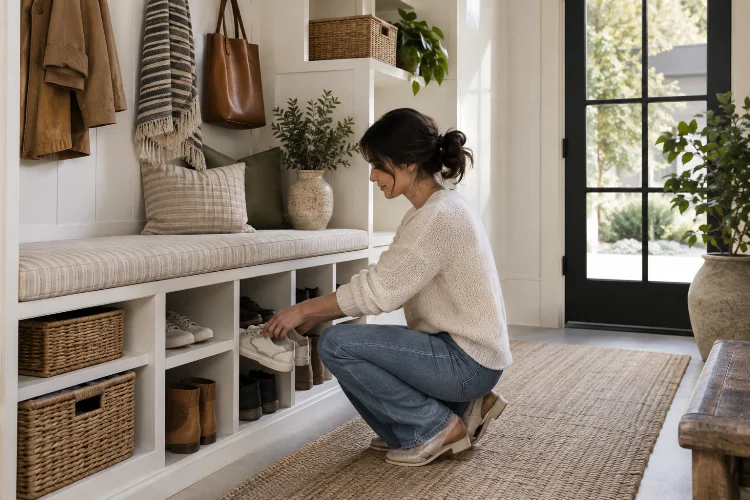
Imagine where you keep everyday shoes.
If returning them requires opening a cupboard, pulling out a box, removing the lid, placing the shoes inside, replacing the lid, and pushing the box back, leaving them near the door becomes much more tempting.
An open shoe rack may work better.
The same principle applies to laundry baskets, toy storage, recycling bins, paperwork, and pantry items.
Try to make frequently repeated actions one-step whenever possible.
Drop laundry into an open hamper. Put toys into broad baskets. Place incoming mail into one dedicated tray.
You can still use more detailed storage for items that are accessed less often.
The key is recognising that organisation must survive rushed mornings and tired evenings – not just the day when you enthusiastically created it.
6. Label Storage Where Confusion Keeps Happening
You do not need labels on absolutely everything.
Most people can identify the cutlery drawer without a sign telling them what it contains.
Labels become valuable when several people share a space, categories look similar, or items frequently end up in the wrong place.
A pantry, children’s playroom, craft cabinet, garage, utility cupboard, or shared office may benefit significantly from simple labels.
Keep categories broad enough to be practical.
Instead of creating seperate containers for every tiny type of children’s toy, categories such as “Building Toys,” “Art Supplies,” and “Vehicles” may be easier for everyone to follow.
A system that is technically perfect but confusing for other household members will not stay organised for long.
The goal is clarity.
Someone should be able to look at the storage area and understand where an item belongs without needing instructions.
7. Leave Some Empty Space in Every System
One surprisingly useful storage principle is not filling everything completely.
A shelf packed from edge to edge may look efficient, but it leaves no flexibility.
New groceries arrive. Someone receives a birthday gift. You buy another towel. Suddenly there is nowhere for anything new to go.
Leaving a little breathing room makes the system more adaptable.
It also makes objects easier to remove and return.
If every drawer needs to be compressed before it can close, your system is already under pressure.
Think of unused capacity as part of the design rather than wasted space.
This can also help reduce unnecessary buying. Before adding another item to a full category, you have a clear signal that something may need to leave first.
EPA guidance emphasizes reducing consumption and reusing existing goods as effective ways to reduce household waste.
8. Build a Five-Minute Daily Reset
Even the best storage system will not keep itself perfectly organised.
Life happens.
A jacket ends up on a chair. Mail lands on the counter. Toys migrate into the hallway.
Instead of waiting until the home becomes chaotic, use a very short daily reset.
Spend five or ten minutes returning frequently misplaced objects to their homes. Focus especially on shared surfaces such as tables, kitchen counters, sofas, and entryways.
This works because repetition in a stable context can strengthen routines and gradually reduce the amount of conscious effort needed to perform them.
You could attach the reset to something you already do.
After dinner, clear the kitchen counter. Before bed, return living-room items. After finishing work, reset your desk.
Do not turn this into a major cleaning session.
The purpose is simple daily maintainance, not perfection.
9. Review the System When Clutter Keeps Returning
Recurring clutter is information.
If the same pile appears repeatedly, do not immediately blame yourself or your family.
Ask why it keeps appearing.
Maybe the designated storage is too far away. Perhaps the container is too small. The category might be unclear, or the item may not have a home at all.
For example, if jackets always collect on dining chairs even though you have a coat cupboard, perhaps opening that cupboard is inconvenient during a busy morning.
A few wall hooks may solve the problem better than repeatedly telling everyone to use the existing system.
Mayo Clinic guidance on decluttering similarly recommends breaking organisation into manageable tasks rather than trying to tackle everything at once.
Treat storage systems as adjustable.
Your home changes, your routines change, and the system should change with them.
Understanding how to create storage systems that stay organised daily is not really about buying prettier containers. It is about removing friction from everyday life.
Store items where you naturally use them, group similar possessions, keep frequent-use objects accessable, create realistic limits, and make putting things away as simple as possible.
Then support the system with a short daily reset rather than waiting for another exhausting weekend reorganisation.
Start with one problem area today. Notice what keeps accumulating, identify why it happens, and redesign that small space around your actual routine.
When your storage system works with your habits instead of against them, staying organised becomes far more consistant – and much less stressful.