Learning to cook can feel intimidating when you are a complete beginner. Recipes casually tell you to “sauté until golden,” “season to taste,” or “simmer gently” as if everyone automatically knows what those instructions mean.
The truth is that nobody starts out knowing how to cook.
Cooking is a collection of small skills that become easier through repetition. You do not need expensive equipment, dozens of cookbooks, or the ability to prepare complicated restaurant-style dishes.
Learning how to learn basic cooking skills as a complete beginner starts with understanding a few simple techniques and practicing them with forgiving recipes.
Knowing how to prepare your own meals can also give you more control over ingredients, portions, flavors, and food spending.
More importantly, cooking becomes much less stressful once basic tasks such as chopping vegetables, boiling pasta, cooking eggs, and seasoning food start feeling familiar.
Instead of trying to become an amazing cook immediately, focus on becoming comfortable in the kitchen.
Here is where to begin.
1. Start With a Few Basic Kitchen Tools
You do not need a kitchen filled with gadgets.
A beginner can cook an impressive number of meals with a few basic tools: a chef’s knife, cutting board, frying pan, saucepan, baking tray, wooden spoon or spatula, mixing bowl, measuring cups or spoons, and a food thermometer.
Buy tools based on what you actually cook.
If you rarely bake, you probably do not need ten different baking pans. If you mostly prepare simple stovetop meals, invest first in a decent pan and knife.
A sharp knife is particularly useful because it gives you more control than a dull one. Learn to keep your fingers away from the blade and work slowly until cutting feels natural.
Your kitchen does not need to look professional. It simply needs to make everyday cooking easy.
2. Learn Basic Knife Skills
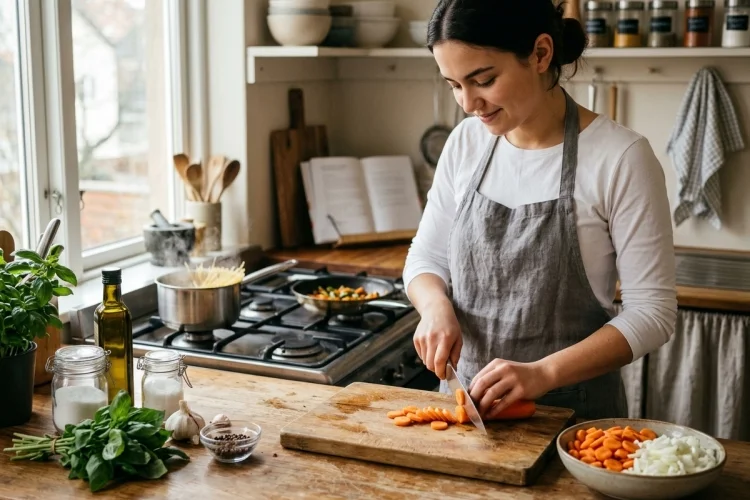
Chopping ingredients is one of the first practical skills worth developing.
Start with easy foods such as onions, carrots, potatoes, cucumbers, and bell peppers. Practice cutting ingredients into reasonably similar sizes rather than worrying about perfectly identical pieces.
Why does size matter?
Food cut into similar pieces tends to cook more evenly. If one potato piece is enormous and another is tiny, the small piece may become soft while the larger one is still undercooked.
Focus on Control Before Speed
Ignore videos of professional chefs chopping onions at incredible speed.
Speed comes later.
Place your cutting board on a stable surface and hold your knife comfortably. Keep the fingertips of your non-knife hand slightly curled away from the blade while holding the ingredient.
Work slowly and deliberately.
The goal is not to impress anyone. It is to build confidence and consistency.
3. Understand the Most Common Cooking Methods
Many recipes are simply different combinations of a few fundamental cooking techniques.
Boiling means cooking food in liquid that has reached its boiling point. You will use it for pasta, potatoes, eggs, and many vegetables.
Simmering uses gentler heat. The liquid has smaller bubbles rather than aggressively boiling. Soups, sauces, and stews are often simmered.
Sautéing means cooking relatively quickly in a small amount of fat over moderate or moderately high heat. Onions, vegetables, chicken pieces, and many stir-fry ingredients can be cooked this way.
Roasting uses dry heat in an oven and works well for vegetables, potatoes, meat, and fish.
Once you understand what these words mean, recipes immediately become less confusing.
Instead of memorizing hundreds of dishes, learn techniques that can be reused across dozens of meals.
4. Practice With Simple, Forgiving Recipes
Your first recipe probably should not be beef Wellington.
Choose meals with relatively few ingredients and simple instructions.
Scrambled eggs teach you heat control. Pasta teaches boiling and timing. Vegetable soup introduces chopping and simmering. Stir-fried vegetables teach sautéing, while roasted potatoes help you understand oven cooking.
A basic rice bowl can combine several beginner cooking skills.
Cook rice, sauté some vegetables, prepare eggs, tofu, chicken, or another protein, and add a simple sauce. Even if the meal does not look beautiful, you have practiced multiple techniques.
Try cooking the same dish several times rather than constantly changing recipes.
The first attempt teaches you the instructions. The second teaches you what went wrong. By the third or fourth attempt, you begin understanding how to improve it without relying completely on the recipe.
That is how cooking confidence develops.
5. Learn How Heat Changes Food
One of the biggest differences between nervous beginners and comfortable home cooks is understanding heat.
Turning the stove to maximum does not make everything cook better.
High heat can be useful for browning certain foods, but it can also burn the outside before the inside cooks properly. Medium or low heat gives you more time to control what is happening.
For example, eggs generally benefit from relatively gentle heat. Onions cooked slowly can become soft and sweet, while higher heat may brown them quickly.
Pay attention to visual and sensory clues.
Is the oil smoking? Is the food browning too fast? Is your sauce barely moving or aggressively boiling?
Cooking is partly about adjusting the heat based on what you see rather than treating the temperature setting as something that can never change.
6. Learn to Season Food Gradually
Food can be perfectly cooked and still taste disappointing if it is poorly seasoned.
Salt is one of the most important basic seasonings because it helps enhance existing flavors. However, adding a huge amount at the end is usually less effective than seasoning gradually.
Add a little, taste when appropriate, then adjust.
Other beginner-friendly flavor builders include black pepper, garlic, onion, lemon or lime juice, fresh herbs, dried herbs, chili, vinegar, soy sauce, and spices.
You do not need 40 spice jars immediately.
Start with seasonings commonly used in foods you enjoy.
Learn the Basic Balance of Flavor
When food tastes flat, it does not always need more salt.
Sometimes it needs acidity from lemon juice or vinegar. A tomato sauce may benefit from herbs, while a soup may need more savory depth.
Taste thoughtfully and ask yourself what seems missing.
Over time, “season to taste” will stop sounding mysterious because you will have developed a better idea of what balanced food tastes like.
7. Learn Basic Food Safety From the Beginning
Good cooking skills include knowing how to handle food safely.
FoodSafety.gov recommends four basic food-safety steps: Clean, Separate, Cook, and Chill. That means keeping hands and surfaces clean, separating raw foods that could spread harmful germs, cooking foods adequately, and refrigerating perishable foods promptly.
Cross-contamination is particularly important for beginners to understand.
Do not let raw meat or poultry juices contaminate ready-to-eat foods. Wash hands, utensils, cutting boards, and surfaces appropriately after handling raw animal products.
FoodSafety.gov also advises against washing raw poultry, meat, or seafood because splashing water can spread germs around the kitchen.
A food thermometer removes much of the guesswork when cooking meat.
For example, FDA guidance lists a minimum internal temperature of 165°F (74°C) for poultry and 160°F (71°C) for ground beef, pork, veal, and lamb.
Safe cooking is a skill worth learning from your very first meal.
8. Read the Entire Recipe Before You Start
Many beginner cooking disasters happen because someone starts cooking after reading only the first sentence.
Then they discover halfway through that an onion was supposed to be chopped, the oven should already be hot, or the chicken needed to marinate beforehand.
Read the recipe from beginning to end.
Check how long it takes, which ingredients you need, what needs chopping, and what equipment is required.
You can also prepare ingredients before turning on the stove.
Professional kitchens often use the idea of mise en place, meaning having ingredients prepared and ready before cooking begins.
You do not need dozens of tiny bowls.
Simply chopping your vegetables, opening cans, and measuring important ingredients in advance can make cooking much calmer.
9. Learn From Mistakes Instead of Throwing Away the Recipe
You will burn something eventually.
You will oversalt soup, undercook potatoes, make rice too wet, or completely forget an ingredient.
That is normal.
Instead of deciding you are “bad at cooking,” figure out what happened.
If vegetables burned, perhaps your heat was too high. If chicken was dry, maybe it cooked too long. If pasta was mushy, reduce the cooking time next time.
Cooking improves through feedback.
Keep simple mental notes-or actual notes-about recipes you regularly prepare.
“Use less salt.”
“Cook five minutes longer.”
“Add more garlic.”
These tiny observations gradually turn someone who follows recipes into someone who understands cooking.
10. Build a Small Collection of Reliable Meals
You do not need to know how to prepare 100 recipes.
Start with five.
For example, learn one egg dish, one pasta meal, one rice-based meal, one soup or stew, and one simple chicken, fish, tofu, or bean dish.
Once those meals feel comfortable, expand gradually.
You might learn homemade tomato sauce, roasted vegetables, fried rice, pancakes, curry, or a basic salad dressing.
This approach gives you reliable options for everyday meals while allowing your cooking skills to develop naturally.
Eventually, you will notice that recipes overlap.
The onions you learned to sauté for pasta also appear in soup. The knife skills you practiced with carrots work with many other vegetables.
That is when cooking starts feeling less like memorizing instructions and more like understanding a system.
Learning how to learn basic cooking skills as a complete beginner is much easier when you stop trying to master everything at once.
Begin with a few essential kitchen tools, practice safe knife skills, understand basic techniques such as boiling, sautéing, simmering, and roasting, and learn how seasoning and heat affect food. Keep food safety in mind and choose simple recipes you can cook repeatedly.
Most importantly, accept that mistakes are part of the process.
Choose one easy meal this week and cook it yourself. Then make it again a few days later and improve one thing.
You do not become confident in the kitchen by reading hundreds of recipes. You become confident by cooking-and each simple meal teaches you something useful for the next one.