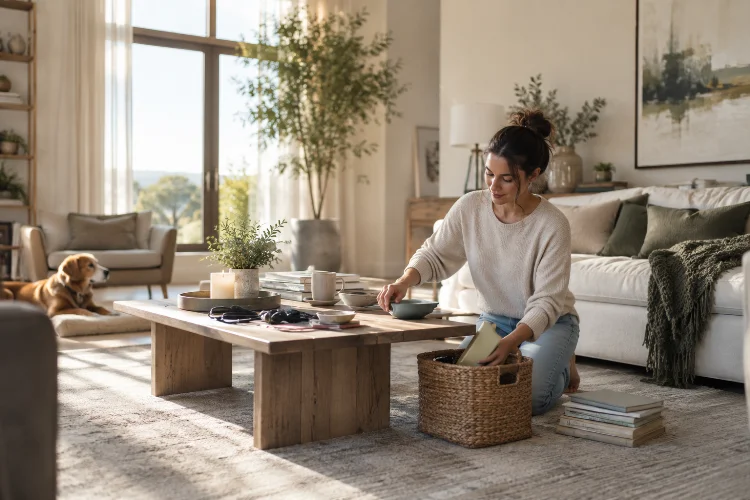
A cluttered home does not always look dramatic. Sometimes it is just a chair covered in clothes, a kitchen counter crowded with unopened mail, or a drawer so full that you avoid opening it unless absolutely necessary.
The problem is that small piles have a habit of multiplying. Over time, clutter can make a room feel harder to use, harder to clean, and strangely more tiring to be in.
Research has also found associations between higher levels of household clutter and lower subjective well-being, although clutter is highly personal and what feels overwhelming to one person may feel normal to another.
The good news is that you do not need to become a minimalist.
Using a few simple decluttering methods for a calmer living space can help you create more breathing room without spending an entire weekend emptying every cupboard.
The goal is not an empty home. It is a home where the things you own are easier to see, use, and enjoy.
1. Start With One Small, Visible Area
The biggest decluttering mistake is starting too big.
You look around the house, notice everything at once, and decide you need to organize the bedroom, kitchen, garage, wardrobe, and paperwork in a single weekend.
That usually becomes overwhelming.
Instead, choose one small area where progress will be obvious. It could be a bedside table, bathroom counter, one kitchen drawer, or the top of your desk.
Visible improvement creates momentum.
For example, clearing a crowded coffee table may take only 15 minutes, but the room can immediately feel more spacious. That quick result makes moving to the next area easier.
Research on visual attention also shows that our brains have to filter competing information in cluttered environments. In simple terms, more visible objects can mean more things competing for attention.
You do not need perfectly empty surfaces, but reducing unnecessary visual noise can make a room feel easier to navigate.
2. Use the Keep, Relocate, Donate, and Discard Method
Decluttering becomes easier when every object has a clear decision attached to it.
Instead of creating one giant pile labeled “deal with later,” sort items into four basic categories: keep, relocate, donate, or discard.
The keep category is for things that belong in the space and are genuinely useful or meaningful.
Relocate is for useful items that simply ended up in the wrong room. A screwdriver on the dining table might belong in a toolbox. A book on the kitchen counter may need to return to a shelf.
Donate items that are still useful but no longer serve you.
The U.S. Environmental Protection Agency encourages donating or selling usable clothing, appliances, tools, books, furniture, and other household goods rather than automatically sending them to landfill.
Discard should generally be reserved for broken, expired, unusable, or unsafe items that cannot reasonably be reused.
The key is seperating decisions from emotions. Instead of asking, “Could I possibly need this someday?” ask, “Would I realistically look for this if I needed it?”
That question often makes the decision much easier.
3. Declutter by Category When Rooms Feel Overwhelming
Room-by-room decluttering works well for many people, but sometimes clutter is spread throughout the entire house.
You may have cables in three drawers, stationery in five rooms, and reusable shopping bags hiding everywhere.
In that situation, decluttering by category can be more effective.
Start with something manageable, such as shoes, mugs, toiletries, cleaning products, or charging cables. Gather similar items together so you can actually see how many you own.
This can be surprisingly revealing.
You might think you own four water bottles until you discover twelve scattered across cupboards, bags, and your car.
Seeing everything together makes duplicates easier to identify and reduces unnecessary repurchasing.
Do not begin with highly emotional categories such as family photographs or sentimental gifts. Start with easier decisions and build confidence first.
4. Try the Five-Minute Decluttering Rule
A calm home does not require marathon cleaning sessions.
Sometimes five minutes is enough.
Set a short timer and focus on one tiny area. Put away objects, throw out obvious rubbish, return misplaced items, and stop when the timer ends.
Five minutes sounds almost too easy, which is exactly why it works well for people who procrastinate.
Research into clutter behavior has linked clutter with factors such as indecision and decisional procrastination.
A short session lowers the mental barrier to starting.
You may decide to continue once the timer ends, but you do not have to. The goal is to make decluttering feel like routine maintainance, not a major household event.
Five minutes after dinner or before bed can prevent several small piles from turning into a full-room problem.
5. Give Everyday Objects a Clear Home
Decluttering does not work very well if the same objects return to random surfaces two days later.
That is where basic home organization becomes important.
Frequently used items should have logical, easy-to-reach locations.
Keys might live in a small tray near the door. Chargers can stay in one drawer. Mail can go into a single inbox rather than being placed on every available surface.
Storage should make putting things away easier, not more complicated.
If returning an item requires opening three boxes, moving a stack, and lifting a heavy container, you probably will not do it consistently.
Choose storage based on your real habits.
A basket where you naturally drop blankets may work better than forcing yourself to fold them perfectly every evening.
The best organization system is often the one that feels slightly boring but is easy to repeat.
6. Create a “Clutter Boundary” for Problem Areas
Some clutter is unavoidable.
Mail arrives. Bags get dropped near the entrance. Laundry waits to be folded. Children leave toys in shared spaces.
Instead of expecting these things to disappear completely, give them boundaries.
For example, allow incoming paperwork to stay in one tray. Once the tray is full, something has to be filed, recycled, or handled before anything else goes in.
The same method works for clothing, toys, books, or hobby equipment.
A basket, drawer, shelf, or cabinet creates a physical limit.
This prevents clutter from slowly spreading across an entire room.
Research suggests that the experience of clutter is partly subjective. The same number of possessions can feel manageable when contained and organized but overwhelming when scattered throughout a space.
That means organization is not always about owning dramatically less. Sometimes it is about creating clearer limits.
7. Be Careful With Sentimental Clutter
Sentimental possessions are usually the hardest items to declutter.
A broken mug may remind you of university. An old jacket might belong to a previous stage of life. A box of letters may contain memories you have not revisited in years.
There is no reason to become ruthless.
Your home should still contain objects that have meaning.
The problem begins when sentimental value becomes the default reason for keeping everything.
Try choosing representative items instead.
Instead of keeping every childhood school project, keep a few favorites. Instead of storing an entire box of souvenirs, display or preserve the pieces that carry the strongest memories.
You can also photograph bulky items before letting them go.
Remember that decluttering is not about deleting your history. It is about deciding which physical objects deserve space in your current life.
Research on psychological home suggests that possessions can contribute to identity and place attachment, so it makes sense that letting go can sometimes feel emotionally difficult.
8. Prevent Clutter From Coming Back
Decluttering once feels satisfying.
Keeping clutter from returning is the harder part.
A simple strategy is to become slightly more selective before bringing new items home.
Before buying something, ask where it will live, whether you already own something similar, and how often you are likely to use it.
This does not mean never buying anything.
It simply creates a short pause between wanting an object and owning it.
You can also adopt a light “one in, one out” rule for categories that fill up quickly, such as clothes, shoes, mugs, cosmetics, or books.
Weekly reset sessions can help too.
Spend 10 to 20 minutes returning objects to their proper places, clearing common surfaces, and dealing with anything that has started to accumulate.
Small resets are much easier than waiting until your enviroment feels completely unmanageable.
You do not need an empty house, matching storage containers, or a perfectly organized wardrobe to feel better in your space.
The most effective simple decluttering methods for a calmer living space are usually the easiest ones to repeat: start small, make clear decisions, give objects a home, create boundaries, and regularly remove things you no longer use.
Research has repeatedly linked higher household clutter with lower perceived well-being, but creating a calmer home does not require extreme minimalism.
Choose one small area today.
Clear one drawer, one surface, or one basket. Do not worry about the entire house yet.
A calmer living space is usually built one simple decision at a time.