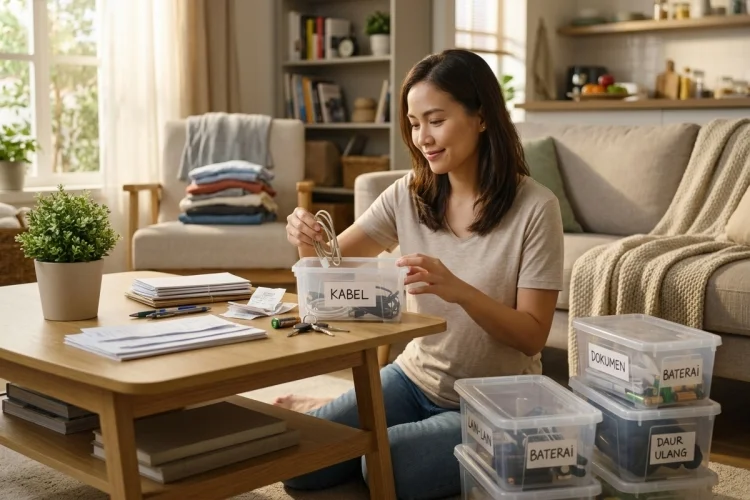
You look around your home and notice clothes on a chair, paperwork on the table, kitchen cupboards packed with things you rarely use, and a mysterious drawer that somehow contains everything from batteries to old receipts.
Suddenly, “organising the house” feels less like a weekend project and more like a full-time job.
The good news is that your home does not need to become perfectly organised overnight. Learning how to organise your home without feeling overwhelmed is mostly about breaking a large project into smaller, manageable decisions.
Research has even suggested that the way people experience clutter at home may be connected with stress. In one study involving 60 dual-income couples, women who described their homes as more cluttered and unfinished showed patterns associated with greater daily stress.
So the goal is not to create a picture-perfect home. It is to make your space easier to use, easier to maintain, and more comfortable to live in.
Here is how to start without exhausting yourself.
1. Stop Trying to Organise the Entire House at Once
One of the easiest ways to become overwhelmed is to make your goal too big.
“Organise the house” sounds like one task, but it actually contains hundreds of smaller tasks. You may need to sort clothes, deal with paperwork, clear kitchen cabinets, organise bathroom products, review children’s toys, and decide what to do with sentimental items.
Instead, shrink the project.
Utah State University Extension recommends beginning with one small area rather than trying to declutter everything at once. A single drawer, shelf, cupboard section, or part of a closet is enough.
Use the One-Space Rule
Choose one clearly defined space.
Not “the kitchen.” Choose the cutlery drawer.
Not “the bedroom.” Choose one bedside table.
Set a timer for 15 or 20 minutes and work only on that area. When the timer ends, you can stop.
Finishing one small space gives you visible progress without creating the exhausting feeling that your whole house must be completed today.
2. Declutter Before Buying Storage
Storage boxes are incredibly tempting.
When your home feels messy, buying baskets, containers, drawer organisers, and shelving can feel like the obvious solution.
But storage does not automatically solve clutter.
If you have too many things, containers may simply help you organise items you do not actually need.
Utah State University Extension recommends reducing possessions before investing heavily in storage. Once you have fewer unnecessary items, you may discover that you need far fewer boxes, bins, and organisers than expected.
Go through your belongings first.
Ask whether an item is useful, regularly used, genuinely meaningful, or appropriate for your current lifestyle.
Only after deciding what stays should you think about where to store it.
That order-declutter first, organise second-usually creates a much simpler system.
3. Use Simple Categories When Decluttering
Decision fatigue can make organising exhausting.
If you pick up every item and spend five minutes wondering what to do with it, you will quickly lose motivation.
Create a simple sorting system.
Four categories are usually enough:
Keep, Donate/Sell, Recycle, and Trash.
University of Illinois Extension recommends a similar four-box strategy and suggests setting a time limit so that the process does not turn into hours of looking through sentimental items.
You can also add a temporary “Unsure” box if you genuinely cannot decide.
However, give that box a deadline. Revisit it in a month or two rather than allowing it to become permanent storage.
The fewer decisions you have to make, the easier decluttering becomes.
4. Give Every Item a Logical Home
Many homes become messy for a surprisingly simple reason: items do not have an obvious place to go.
When something has no designated home, it ends up on a table, chair, countertop, or floor.
A better organisation system makes putting things away almost automatic.
Keep objects close to where they are actually used.
Coffee supplies belong near the coffee maker. Towels belong close to the bathroom. Charging cables can stay near the places where devices are usually charged.
The same logic applies to keys, mail, shoes, cleaning supplies, children’s toys, and everyday paperwork.
Utah State University Extension notes that giving belongings a “home” can make maintaining an orderly space easier.
Organise for Real Life, Not Appearance
Do not organise your home according to what looks perfect in a photograph.
Organise around your actual habits.
If everyone in your family drops their keys near the front door, place a tray or hook there instead of expecting everyone to carry their keys to a beautifully organised drawer in another room.
A useful system works with your behaviour rather than constantly fighting against it.
5. Focus on High-Impact Areas First
Some clutter creates more frustration than others.
A messy storage cupboard that you open twice a year probably matters less than a kitchen counter you use every morning.
Start with spaces that affect your daily routine.
Entryways, kitchen counters, dining tables, bathroom surfaces, bedside tables, and frequently used drawers are often good candidates.
Clearing these areas can make your home feel noticeably calmer even if plenty of hidden spaces still need attention.
Research on visual attention shows that multiple objects in our visual field compete for processing, requiring the brain to filter irrelevant information.
That does not mean every object in sight is harmful, but reducing unnecessary visual clutter in frequently used spaces may make them feel simpler and easier to navigate.
Choose the areas you see and use most often.
6. Create a Simple System for Paper
Paper clutter has a special ability to spread.
Mail arrives. Receipts appear. School papers accumulate. Bills get placed somewhere “for later.”
Before long, your dining table becomes an unofficial filing cabinet.
Create one location for incoming papers.
When mail enters your home, avoid distributing it across several rooms. Put it in one tray, folder, or designated area.
Then process it regularly.
Recycle what you do not need, take action on time-sensitive documents, and file anything worth keeping.
A complicated filing system is unnecessary for most households. A few clearly labelled folders may be enough.
The easier your paper system is, the more likely you are to actually use it.
7. Do Not Start With Sentimental Items
Old photographs, children’s artwork, letters, gifts, inherited belongings, and souvenirs can be emotionally difficult to sort.
That makes them terrible starting points.
Begin with easier categories where decisions are more obvious.
Expired products, duplicate kitchen utensils, damaged clothes, old magazines, empty packaging, and items you have not used in years are usually easier.
Once you develop confidence in making decisions, you can move toward sentimental belongings.
You also do not have to throw meaningful objects away simply because they are old.
The purpose of decluttering is not to own as little as possible. It is to intentionally decide what deserves space in your home.
For sentimental collections, consider creating a specific physical limit, such as one memory box.
Then keep the items that matter most rather than storing everything automatically.
8. Use Short Organising Sessions
You do not need six free hours to make progress.
In fact, shorter sessions may make home organisation easier to maintain.
Try a 10-minute reset before bed.
Return objects to their designated places, clear the kitchen counter, put clothes away, and deal with obvious rubbish.
Utah State University Extension recommends incorporating decluttering into daily or weekly routines and describes using very short tidying sessions to keep everyday mess manageable.
The advantage of short sessions is psychological as well as practical.
“Clean everything” feels exhausting.
“Tidy for ten minutes” feels achievable.
Those ten minutes repeated regularly can prevent small messes from becoming major weekend projects.
9. Control What Comes Into Your Home
Organising is much harder when new possessions constantly enter the house.
Before buying something, pause.
Ask yourself where it will live.
Do you already own something that performs the same function? Will you realistically use it? Are you buying it because you need it or simply because it is discounted?
This habit is especially useful after decluttering.
Otherwise, you can spend weeks removing unnecessary possessions only to slowly replace them.
Be careful with “just in case” purchases too.
Keeping a reasonable number of useful backup items makes sense. Keeping ten versions of something you rarely use usually creates another storage problem.
An organised home is easier to maintain when you become slightly more selective about what enters it.
10. Make Organisation Easy for Everyone
If you share your home with family members, housemates, or children, an organisation system needs to make sense to everyone.
A complicated system that only one person understands will probably collapse.
Keep frequently used categories obvious.
Label containers when helpful. Use accessible baskets for children’s toys. Put laundry hampers where clothes are actually removed.
If someone repeatedly leaves an item in the same place, consider whether the storage location needs changing.
The goal is not to make everyone follow a complicated set of household rules.
It is to reduce friction.
When putting an item away takes only a few seconds, people are far more likely to do it.
11. Let Go of the Perfect-Home Standard
Your home is supposed to be lived in.
There will be dishes sometimes. Laundry will appear. Children’s toys will move around. Paperwork will accumulate during busy weeks.
That does not mean your organisation system has failed.
Home organisation should improve function, not create anxiety about maintaining perfection.
Research on clutter also suggests that hesitation and difficulty making decisions can make decluttering harder for some people. A study of 227 adults found that greater indecision and hesitation were associated with greater negative impacts of clutter on quality of life.
So avoid turning every object into a complicated decision.
Make the best choice you can, move forward, and remember that you can adjust your system later.
Progress is much more useful than perfection.
Learning how to organise your home without feeling overwhelmed starts with changing the size of the task.
Forget about organising the entire house in one weekend. Choose one drawer, shelf, countertop, or cupboard and finish that first.
Declutter before buying storage, give important belongings logical homes, create simple systems, and spend a few minutes each day resetting frequently used spaces.
Most importantly, design your home around the way you actually live.
An organised home does not need to look like a showroom. It simply needs to help you find what you need and make everyday life easier.
Choose one small area today, set a 15-minute timer, and start there. One drawer may not transform your whole house-but it can be the first step toward a calmer, more manageable space.