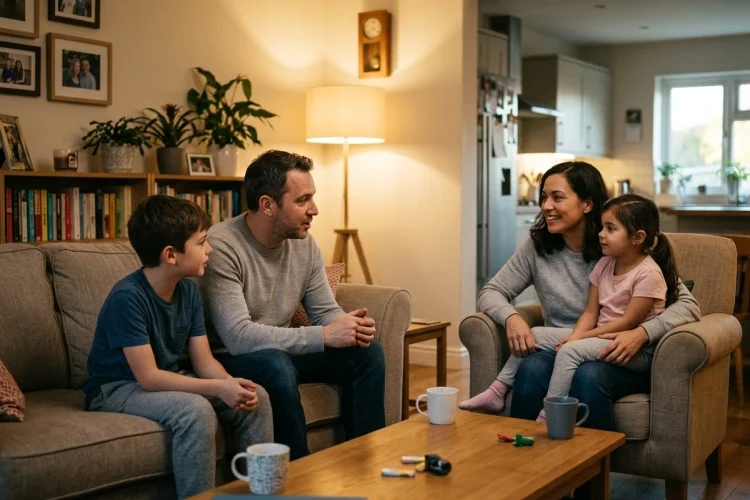
Home is supposed to be the place where communication feels easiest. Yet it is often where misunderstandings happen the fastest.
Someone forgets to take out the rubbish, a child answers with one word, your partner seems unusually quiet, or a small disagreement about household chores suddenly turns into an argument about everything that has happened during the past six months.
Healthy family communication does not mean everyone agrees all the time. It means people can express what they think, listen to each other, handle disagreements with respect, and feel safe enough to talk about problems before they become much bigger.
Learning how to build healthier communication habits at home is less about having perfect conversations and more about improving the small interactions that happen every day.
The American Academy of Pediatrics notes that even short periods of focused, distraction-free conversation can help develop positive communication habits between parents and children.
The same principle applies across households: better communication usually grows from regular attention, not one dramatic family meeting.
1. Make Time for Everyday Conversation
Healthy communication is difficult when people only talk when there is a problem.
If most conversations at home are about unfinished chores, bills, homework, schedules, or complaints, family members may start associating communication with being corrected.
Create opportunities for ordinary conversation too.
Ask how someone’s day went during dinner. Talk while preparing food. Spend a few minutes together before bedtime or while drinking coffee in the morning.
The American Academy of Pediatrics recommends making communication a regular family priority and setting aside time to discuss daily activities, weekly events, and feelings while genuinely listening to one another.
These conversations do not have to become serious emotional discussions every day.
Sometimes simply asking, “What was the funniest thing that happened today?” can make communication feel more natural.
When people regularly talk about small things, discussing bigger problems becomes easier.
2. Practice Active Listening
Listening is not the same as remaining silent while waiting for your turn to speak.
Active listening means trying to understand what the other person is actually communicating.
Put your phone down when possible. Avoid interrupting. Pay attention to tone, facial expressions, and body language.
Utah State University Extension explains that active listening involves consciously understanding both verbal and nonverbal messages. It can help people develop greater trust, empathy, and shared understanding in relationships.
Check That You Understood Correctly
Try briefly reflecting what you heard.
For example:
“So you’re frustrated because you thought I had already agreed to handle that?”
Or:
“It sounds like school was stressful today.”
Reflective listening gives the other person an opportunity to say, “Yes, exactly,” or, “No, that’s not really what I meant.”
That tiny clarification can prevent an unnecessary argument.
The goal is not to prove that your interpretation was right. It is to understand the message accurately.
3. Replace Accusations With Clear Requests
Compare these two statements:
“You never help around the house.”
“I’ve handled the dishes every night this week. Could you do them tonight?”
Both may come from the same frustration, but they create very different conversations.
General accusations such as “you always” and “you never” can quickly make people defensive. Specific requests tell someone what the actual problem is and what could improve the situation.
Mayo Clinic describes assertive communication as direct but respectful. It allows people to express their thoughts, feelings, and needs while also respecting the rights and perspectives of others.
“I” statements can also help.
Instead of saying, “You don’t care about what I say,” try, “I feel ignored when I’m talking and you’re checking your phone.”
You are still expressing frustration.
You are simply focusing on the behavior and its effect instead of attacking the person.
4. Choose the Right Time for Difficult Conversations
Not every moment is a good moment to solve a problem.
Trying to discuss finances while someone is rushing out the door is unlikely to go well.
Neither is confronting a tired child the second they arrive home from school or beginning a serious relationship discussion at midnight when both people are exhausted.
HealthyChildren.org recommends being sensitive to the time and place of conversations and choosing quieter moments when people are better able to listen.
Try asking:
“There’s something I’d like us to talk about. Is now okay?”
That gives the other person a chance to mentally shift into the conversation.
If the answer is no, agree on another time instead of abandoning the subject completely.
Timing does not solve every conflict, but it can dramatically improve the chances of having a productive discussion.
5. Keep the Problem Separate From the Person
One of the healthiest communication habits at home is learning to criticize behavior without attacking identity.
There is a major difference between:
“The kitchen wasn’t cleaned.”
and:
“You’re lazy.”
The first describes a problem.
The second defines the person.
The American Academy of Pediatrics similarly recommends making it clear that problematic behavior is the issue rather than telling a child that they themselves are the problem.
This principle works with adults too.
If your partner forgets an appointment, discuss the forgotten appointment.
If your housemate repeatedly leaves dirty dishes behind, discuss the dishes.
Avoid turning one mistake into a complete personality analysis.
People are more likely to cooperate when they feel they are being asked to solve a problem rather than defend their character.
6. Pay Attention to Tone and Body Language
Communication at home is not just about words.
You can say, “Fine,” in at least ten different ways.
A calm “fine” can signal agreement. A sarcastic “fine” combined with an eye roll sends an entirely different message.
Tone, facial expression, posture, and gestures influence how people interpret what you say.
HealthyChildren.org reminds parents that children learn communication partly by watching adults’ verbal and nonverbal behavior. Using a calm tone, modeling full apologies, and expressing feelings clearly can teach healthier ways of interacting.
Adults influence each other too.
Sarcasm, mocking, constant eye-rolling, or dismissive gestures can make even an ordinary disagreement feel hostile.
If your goal is solving a problem, make sure your tone supports that goal.
7. Create Some Device-Free Conversation Time
Phones are incredibly useful, but they can quietly interrupt household communication.
Someone begins telling you something, your phone vibrates, and your attention immediately moves elsewhere.
Even if you return to the conversation ten seconds later, the message may already be clear: the device won.
The American Academy of Pediatrics recommends creating regular technology-free periods because device use can interfere with both verbal and nonverbal interaction between parents and young children.
You do not need to ban phones from the house.
Choose a few specific moments instead.
Dinner could be phone-free. So could the first 15 minutes after everyone comes home, or a short family conversation before bed.
Small boundaries around technology create more opportunities for genuine attention.
8. Learn How to Handle Conflict Without Trying to Win
Conflict is normal.
Two people living together will eventually disagree about money, parenting, chores, schedules, privacy, noise, food, or a thousand other things.
The goal should not always be winning.
Ask what problem needs solving.
Maybe both people have legitimate concerns.
Instead of trying to prove who is more reasonable, look for the part of the disagreement you can actually address.
The Gottman Institute describes defensiveness as a common response to criticism and recommends accepting responsibility for your part of a conflict rather than automatically shifting blame.
That might sound like:
“You’re right. I said I’d call, and I forgot.”
Taking responsibility does not mean accepting blame for everything.
It simply prevents every disagreement from becoming a courtroom where both people are gathering evidence against each other.
9. Normalize Apologies and Repair
Healthy households are not homes where nobody says the wrong thing.
They are places where people know how to repair communication after something goes wrong.
If you snap at someone because you are stressed, acknowledge it.
“I’m sorry I spoke to you like that. I was frustrated, but that wasn’t fair.”
Avoid apologies that secretly contain another accusation:
“I’m sorry you got upset.”
Or:
“I’m sorry, but you started it.”
A genuine apology focuses on your own behavior.
HealthyChildren.org specifically recommends modeling complete apologies when teaching children healthy communication.
Adults benefit from the same habit.
Repairing small moments quickly can prevent resentment from accumulating.
10. Have Short Family Check-Ins
You do not need a formal two-hour family meeting every Sunday.
Try a 10-minute check-in.
Ask what went well this week, what has been difficult, and whether anything needs to change.
For example, maybe mornings have become chaotic because everyone needs the bathroom at the same time.
Instead of repeatedly arguing about it, discuss the practical problem and create a better routine.
Family rituals and regular opportunities for conversation can strengthen connection by creating predictable times when people share experiences and listen to one another.
Keep these meetings short enough that people do not dread them.
The purpose is not to create another household obligation.
It is to catch small communication problems before they become big ones.
11. Make Appreciation Part of Everyday Communication
Home communication should not become a constant stream of corrections.
Notice what people do well.
Say thank you.
“I appreciate you doing the shopping.”
“Thanks for cleaning that up without being asked.”
“You handled that situation really calmly.”
Specific appreciation is more meaningful than vague praise because it tells the person exactly what you noticed.
HealthyChildren.org recommends using specific praise and positive communication with children rather than allowing interaction to become dominated by commands, criticism, or fault-finding.
The principle works across relationships.
People are usually more open to feedback when they know communication also includes appreciation.
12. Remember That Healthy Communication Takes Practice
Communication habits develop over years.
That means changing them takes time.
You may still interrupt occasionally.
You may become defensive.
Someone will probably say something in the wrong tone after a stressful day.
That does not mean the new habits are failing.
Notice what happened, repair it where necessary, and try differently next time.
Utah State University Extension emphasizes that listening and healthy relationship communication are skills that improve through intentional practice rather than something people automatically do perfectly.
Progress may look surprisingly ordinary.
One fewer argument.
One clearer request.
One conversation where someone felt genuinely heard.
Those small changes are exactly how healthier communication becomes the normal culture of a home.
Learning how to build healthier communication habits at home is not about eliminating disagreement. It is about changing how people respond when needs, emotions, and opinions differ.
Make room for regular conversations, listen without immediately preparing a response, express requests clearly, and focus criticism on specific behaviors rather than personal character.
Choose better times for difficult discussions, reduce digital distractions, apologize when necessary, and make appreciation part of everyday interaction.
Most importantly, start small.
At your next family conversation, practice just one habit: put your phone down and listen until the other person finishes speaking.
Better communication rarely comes from one perfect conversation. It develops through hundreds of small moments where people choose curiosity, clarity, and respect.